Julia Gilles
 ” style=”object-position:50% 0%” data-object-fit=”cover” data-object-position=”50% 0%” >
 ” style=”object-position:50% 0%” data-object-fit=”cover” data-object-position=”50% 0%” >
Curriculum Vitae
Julia Gilles (b. 1993), a young and talented ceramicist, works in Dieulefit, France.
From an early age, she started working with clay under the guidance of her mother, who is also a ceramist. This early exposure to the world of ceramics led to the development of her unique style, in which she combines shapes, materials and colours – especially blues and greens – to create imaginative landscapes.
Although initially attracted to music and sound and later video, she chose to pursue literary training in film and audiovisual art in 2011. However, the desire to create with her own hands took over, and she decided to delve into the applied arts and she decided to embark on the applied arts and finish her training as a ceramist in La Maison de la Céramique du Pays de Dieulefit.
She exhibited in France, Germany and for the first time in Belgium in 2025 at Galerie Adrienne D.
As a young talent, she made the press in ’24 in La Revue de La Céramique et du Verre in the article “landscape painter”
Inspiration
In her own words, ‘in my creations, I try to convey what touches me. Shapes, textures and hues intuitively fuse to show my interpretation of the world. With the superposition of enamel, I want to compose colourful and abstract landscapes. I like to play with contrasts, round volumes, wild reliefs. Raw colours, bare earth or soft, satin enamel. Sometimes organic forms with mineral skin. These ambivalences reflect the diversity I perceive in nature, with its strong but also weak elements, weathering, wear and tear and timelessness.’
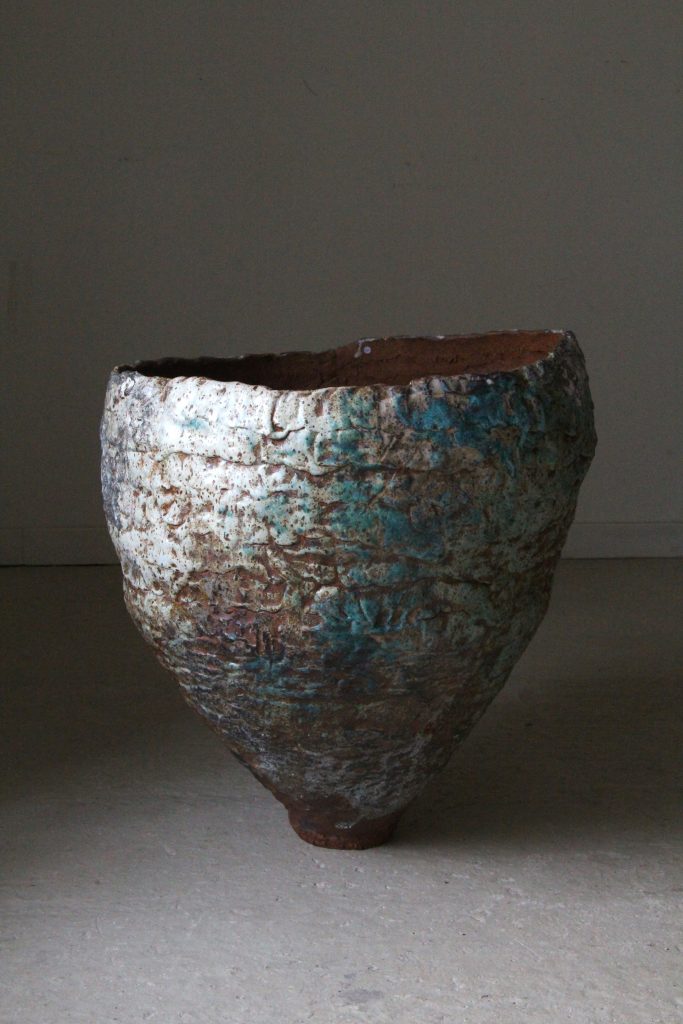
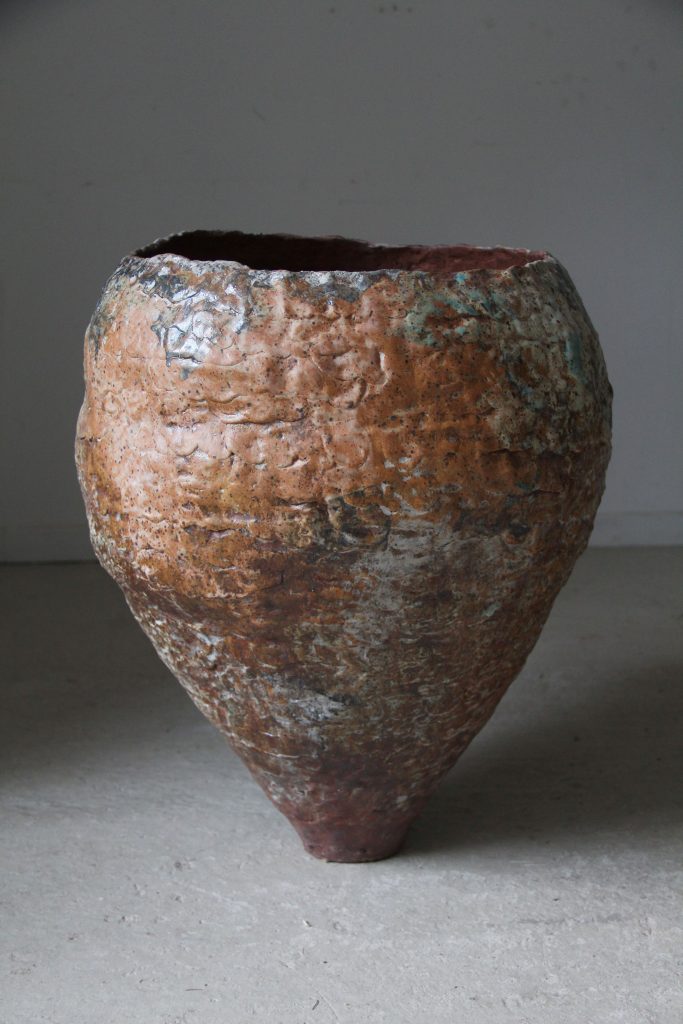
Her large vase sculptures are inspired by African ceramics. They are built slowly with rolls of clay and bear the marks of the maker, hands and rhythm of creation.
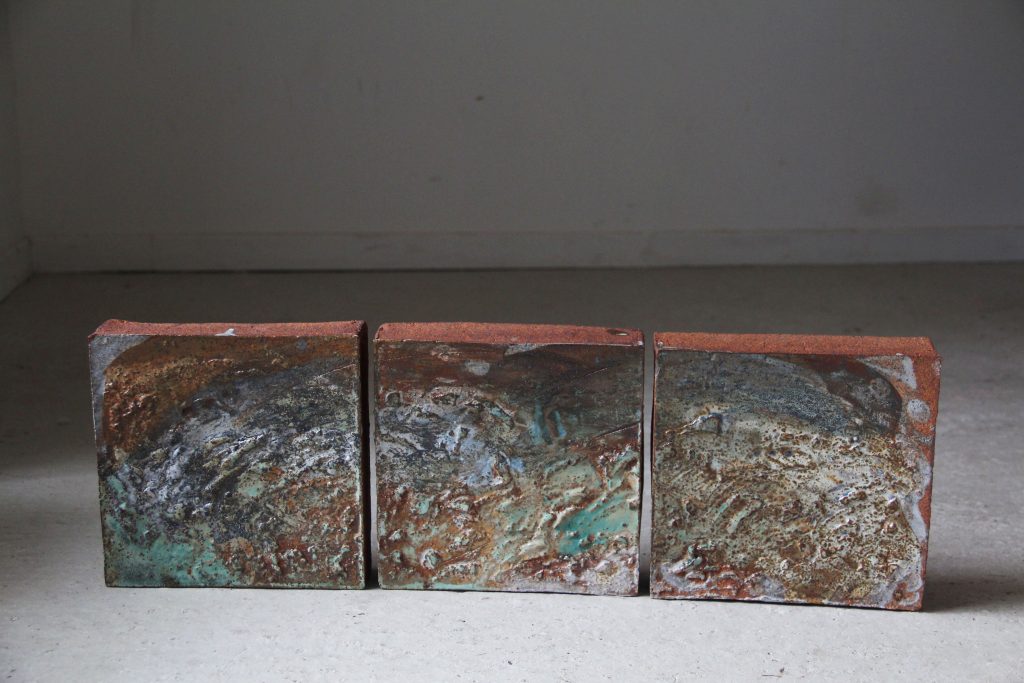
Since 2019, she has also been making wall panels and triptychs.
Julia’s ceramics seem to come straight from a landscape: rough and wild by their assertive mineral character, sensitive and soft by the delicate tones of their colours. The surfaces and shapes are vibrant and bear the traces of erosion, which give her objects a timeless character. She values colour and uniquely brings it to life in her work.
Technique
Julia first learned to turn and spent several years apprenticing with renowned ceramists. Although she took classes with artists who turn large volumes, she discovered her preference for building sculptures with rolls of clay. In this technique, she found her liking and creativity, which led to the large sculptures that are now her trademark.
The clay is rough and with lots of chamotte, but the edge is finely finished. The red natural clay remains visible on the inside of the sculpture, while the outside is finished with several layers of glaze applied with a brush to highlight the fingerprints and form a landscape. The overlapping colours create new nuances, ranging from green and blue to yellow, orange, purple and white. Julia is particularly interested in painting, light and reflections.
Showing all 3 results